NATO Summit Edition: Q3 2026
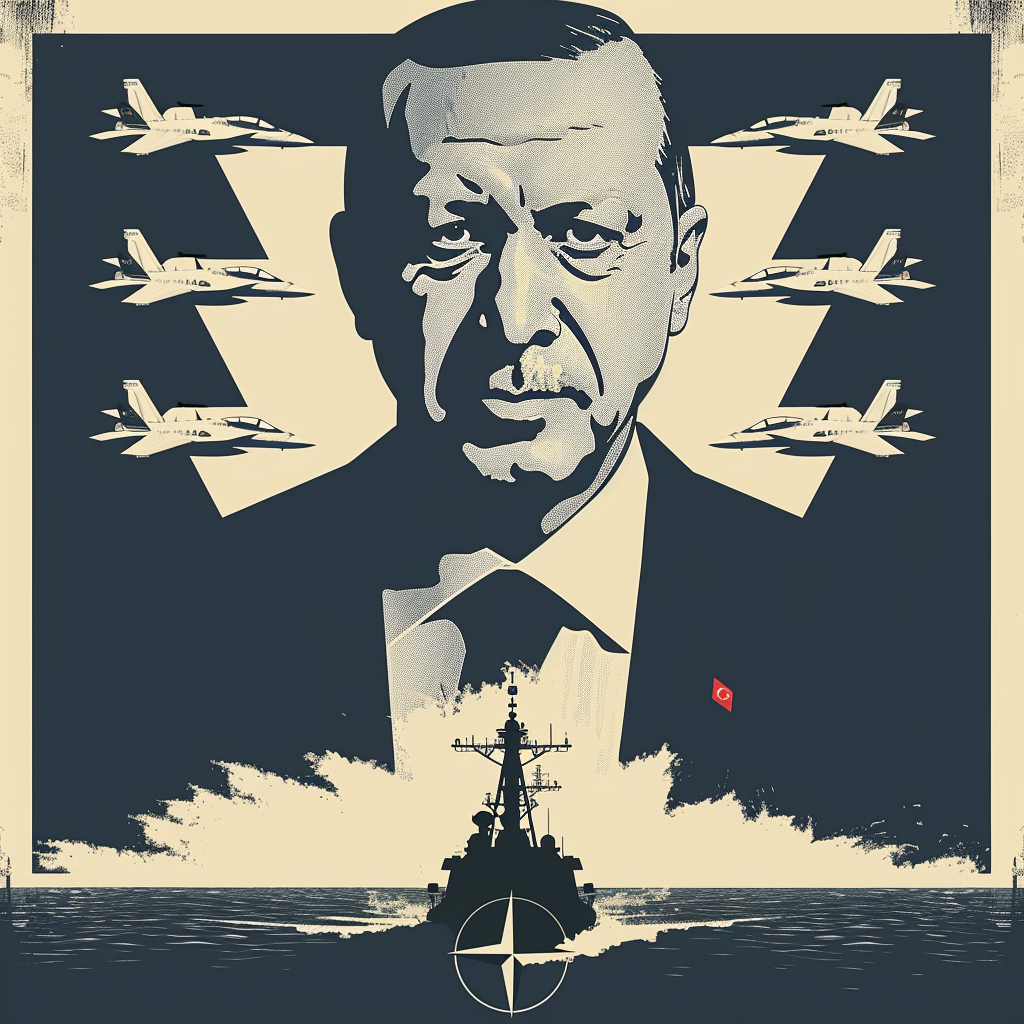
In July 2016, Recep Tayyip Erdoğan conducted one of the more extraordinary acts of political self-preservation in modern history. With tanks on the streets of Ankara and fighter jets breaking the sound barrier over his capital, he held up a phone to a FaceTime camera and addressed the Turkish nation through a CNN anchor's handset. The image was undignified, improvised, and entirely effective. By morning the coup had failed, and Erdoğan was consolidating power with the purposeful speed of a man who understood that the window for doing so was brief.
The silence from certain Western capitals in those critical hours when the coup's outcome was still uncertain was noted in Ankara. The Russian president, by contrast, called immediately. His backing was unambiguous and personal, and what followed was not coincidental: TurkStream negotiations accelerated, the S-400 deal moved forward, a mini-rapprochement opened between Moscow and Ankara that has never fully closed. Erdoğan drew the lesson that Western alliance partners were, at minimum, not displeased by the prospect of his removal. That lesson was a sobering one, and Turkish foreign policy took it fully into account in the decade that followed.
Having said that, the 2016 rapprochement with Moscow was a message to the West, not a commitment to Russia. TurkStream, the S-400, the Syria coordination — these were tactical adjustments in response to a specific moment. They were never a fundamental realignment of Turkish foreign policy.
The NATO leaders who gather in Ankara on 7 and 8 July 2026 include some of those same governments, or their direct successors. They arrive as Erdoğan's guests, in Erdoğan's capital, at a summit whose agenda is substantially shaped by Turkish priorities, to discuss an alliance whose most consequential current questions all run through the Bosphorus and the Dardanelles. Quite a mood change...
I. Skin In The Great Game
There is no longer a single Western position on most of the questions that matter inside that room. There are several, and they follow geography rather than ideology, proximity to the threat rather than the wording of the treaty.
The Baltic states, Scandinavia, Poland, Germany and the United Kingdom have effectively fused into a northern security bloc that acknowledges no red lines on Ukraine and is rearming at a pace not seen since the Cold War. Germany's remilitarisation is the most significant structural shift in European security in a generation. This is a country that spent eighty years cultivating strategic pacifism as a form of penance but now building the largest conventional military in Europe, debating nuclear sharing, and funding defence at levels that would have seemed fantastical five years ago.
Southward, the picture changes entirely. Spain made a moral stand over Gaza, broke with the Anglo-American line, and refused its bases for the American Iran operation. This is not an act of anti-Americanism but the expression of a Mediterranean strategic culture that has always distinguished between the alliance's European core mission and American adventures in adjacent theatres. Sánchez understood that his electorate was watching and acted accordingly, which is what democratic leaders occasionally do.
Italy is more complicated. The cultural affinity with Washington is genuine but Brussels has tamed the shrew through fiscal dependency. The ECB transfers, the recovery funds, the structural loans that underpin Italian public finances do not arrive without European political alignment attached, and Rome has learned to work within that constraint. Italy's foreign policy reflects its position: culturally aligned with Washington, fiscally dependent on Brussels, and rational enough to know the difference between the two.
France is its own universe, as it has always insisted on being. Paris is angrier at Moscow than its Mediterranean geography would suggest, but the anger has a specific address. Wagner's successors expelled French influence from Mali, Burkina Faso and Niger. The message from Moscow was not subtle: you operate in our Caucasian backyard, we operate in yours. Macron read it correctly. The result is a France pushed toward the harder line on Russia while simultaneously pursuing European strategic autonomy, maintaining a bilateral channel with Moscow that the Anglo-Americans distrust, and positioning itself as the only European power capable of filling the nuclear guarantee gap if American commitment continues to erode. France is playing three games simultaneously. It is reasonably good at all of them and dominant in none.
II. Ukraine: The Litmus Paper
Ukraine is the summit's stated primary concern and its most carefully avoided honest conversation. The formal position is unity of support. The operational reality is a spectrum wide enough to contain the Baltic states — who would welcome direct NATO military involvement and say so with increasing frequency — and Hungary, which has blocked aid packages, maintained barely concealed sympathy for Moscow, and continues to exist inside the alliance through a combination of treaty obligation and the political cost of expulsion being higher than the political cost of tolerance.
Most of the membership sits between these poles in a condition of committed anxiety. Genuinely supportive of Ukrainian survival, genuinely nervous about what escalation looks like, and genuinely unwilling to name the threshold at which their support ends. That threshold exists but nobody will specify it. This is probably wise in tactical terms and certainly dishonest in strategic ones.
Into this spectrum, Turkey has inserted itself with the pragmatic dexterity that has characterised its foreign policy for centuries. Ankara supplied Ukraine with Bayraktar drones in the early stages of the war, when they briefly reshaped the tactical picture and made Turkey look like Kyiv's indispensable partner. That moment passed. Russian countermeasures adapted, the drones became less decisive, and Turkey's real relationship with Moscow — transactional, mutually useful, a decade in the building since that 2016 phone call — quietly reasserted itself. Russian energy kept flowing. Russian tourists kept arriving. Russian entities kept using Turkey to navigate Western sanctions.
The pattern is not new. It runs back centuries of Turkic statecraft: orient toward the strongest available patron, extract maximum value, pivot when the calculation changes. Russia served its purpose. Trump is back. The pivot is underway. Turkey simultaneously arms Ukraine, sustains Russia, and positions itself as the alliance's indispensable southern anchor. Neither side has found it profitable to force a choice, which is precisely the outcome Ankara has engineered.
The S-400 purchase is sometimes cited as evidence of a deeper Turkish pivot toward Russia. It was nothing of the sort. If Moscow genuinely expected a strategic realignment in exchange for selling Ankara an air defence system, that was naive. Turkey extracted the transaction, made the geopolitical statement it needed to make, and moved on. The system's actual value to the bilateral relationship has always been low — a symbol, not a substance. Russia, currently focused on not antagonising Turkey while the Ukraine war continues, is in no position to demand clarification. That audit will come once the war ends, when the full transactional nature of the relationship becomes impossible to paper over with wartime necessity.
III. Cold War In The Med
The summit's most significant unspoken agenda item has nothing to do with Ukraine. In the years since October 7, a cold war has opened between Turkey and Israel for dominance over the post-war Middle Eastern order, and it is conducting itself through proxies, competing alliances, and the wreckage of Syria in ways that have begun to acquire a momentum of their own. The Western press has largely missed this, being occupied with the more immediate drama of the Gaza operation. It is the more structurally consequential story.
Start with Greece, because this is the region where Western civilisation was born, where the gods of Olympus watched over the wine-dark sea, and where the grudges outlast the empires that created them. The enmity between Greece and Turkey did not begin with a boundary dispute in the Aegean and will not end with one. It runs through centuries of conquest, through the population exchanges and massacres of the early twentieth century, through 1922 when the Greek world in Anatolia — three thousand years old — was extinguished in weeks in scenes of such horror that the survivors carried them across generations. Cyprus in 1974 added another layer of unresolved humiliation. Turkey converting Hagia Sophia into a mosque was felt in Athens not as a domestic religious decision but as a civilisational statement — a deliberate provocation directed at a people for whom that building represents something that cannot be separated from their identity. The maritime disputes and the Blue Homeland doctrine Turkey has now codified into domestic law are simply the current institutional expressions of something much older and much less amenable to diplomatic resolution.
Both peoples are Mediterranean in temperament — which is to say emotional, historically saturated, and inclined toward conflicts that seek victory rather than compromise. The pattern in this part of the world, whether between Serbs and Albanians, Azeris and Armenians, Israelis and Palestinians, tends toward the same endpoint: the hate is real, the memory is long, and the resolution when it comes tends to involve the destruction or exhaustion of one of the participants rather than a negotiated settlement that both can live with. Greece and Turkey have managed, through NATO membership and economic interdependence, to keep this contained for seventy years. The container is under pressure. Both countries are now acquiring or negotiating advanced fighter aircraft, both are increasing defence spending, and both have territorial claims they regard as existential. The geometry is not stable and no summit communiqué makes it more so.
France and the UAE anchor the informal Israel-aligned position. The UAE is the most deliberate case — the one Arab state to have comprehensively doubled down on both Washington and Tel Aviv while its neighbours perform strategic hedging, the one most exposed if American regional commitment falters, and the one whose long-term calculation most clearly treats the Israel-US axis as the durable architecture of the regional order regardless of what happens in Gaza.
Turkey's relationship with Israel sits in a different register — more recent in its rupture, more ambiguous in its texture, and considerably more hypocritical in its practice. The real Turkish concern is not solidarity with the Palestinian cause. It is that an expansionist Israel, operating without meaningful American constraint, is rewriting the rules of the Middle Eastern order in ways that leave insufficient room for Turkish ambition. And yet Turkey continues to transport Azerbaijani oil through pipelines that sustain the Israeli war machine. Turkish companies conduct business with Israeli counterparts through intermediaries. The footsie under the table continues while the rhetoric above it escalates. What changed specifically is Syria: Turkey installed Ahmad al-Sharaa in Damascus and now regards Syria as its strategic backyard. Israel's operations in Lebanon and its pointed military activity inside Syrian territory — in a country Turkey considers its sphere — crossed a line. But crossed lines in this part of the world are rarely permanent, and Turkey's response has been to escalate rhetorically while preserving every economic and intelligence relationship that serves Turkish interests.
The wider Turkish strategic architecture is more impressive than it appears in isolation. Behind the bilateral positioning stands a quietly assembled network: Pakistan's nuclear weight and Muslim-world legitimacy, Saudi Arabia's financial depth and the authority of the Two Holy Cities, Qatar's Brotherhood connections threading through the region's Islamist movements, Azerbaijan as the loyal Turkic junior managing energy routes and providing the proof of concept that pan-Turkic solidarity can be operationalised. This is not a military alliance. It is a framework of strategic depth, being assembled with patient deliberateness against a more militarily capable adversary. The question is whether it constitutes a genuine alternative pole of regional power or merely an impressive collection of relationships that dissolves under pressure. The next decade will answer that.
IV. The Hegemon: Fork In The Road
Two years remain of the Trump administration, and the alliance is already positioning for what comes after, because what comes after determines whether the architecture of the current moment holds or unravels.
The Rubio path represents the Atlanticist preference: a reinvigorated alliance, harder on Russia and Iran, more interventionist in the theatres where American credibility is currently ambiguous. For the northern and eastern bloc, Rubio means a return to the familiar architecture with American leadership operating at full commitment. For Turkey, it means a harder interlocutor — someone less susceptible to the personal transactionalism that has characterised the Trump-Erdoğan relationship and more insistent on the conditions that the current administration has been willing to overlook. The F-35 conversation changes character entirely.
The Vance path goes somewhere structurally different. America First applied with ideological consistency means genuine contraction of American engagement beyond the Western hemisphere. The Monroe Doctrine reasserted in Latin America, studied disengagement from European security beyond what treaty obligations strictly require, and the vacuum in the Eastern Mediterranean and the Middle East filled by whoever moves fastest. For the northern bloc, this is the scenario their rearmament programmes are designed to hedge against — a NATO whose American commitment is genuinely uncertain, requiring European military capacity to take the forward position before that capacity is fully built. For Turkey, it is an opportunity: reduced American presence in the region means more space for Turkish interests without Washington's moderating disapproval.
For Greece, a Vance presidency is alarming in a specific way. The American anchor that has historically constrained Turkish adventurism in the Aegean weakens. The F-35 asymmetry — Greece acquiring them, Turkey negotiating from exclusion — becomes a live military reality rather than a diplomatic data point. The Eastern Mediterranean without a fully engaged American arbiter is a more dangerous place for a smaller country with a larger neighbour that has territorial claims against it.
For Israel, the long-term question sharpens. American support has rested on three foundations: strategic interest, domestic political dynamics, and the moral weight of the Holocaust. The first two are variable. The third is finite and being spent. A Vance administration that is genuinely disinterested in Middle Eastern entanglements changes the strategic calculus for every actor in the region, including Turkey, including Iran, including the Arab states that have built their security architectures around American guarantees they now have reason to doubt.
The sub-groupings already forming — the northern security cluster around Germany and the UK, the Mediterranean reluctants anchored by Spain, the Turkish Sunni network assembling in the south — are all, in their different ways, preparations for a world in which American commitment is conditional rather than automatic. The alliance's formal structure will survive either outcome. What lives inside that structure, what it actually means when tested, depends entirely on which path American politics takes after 2028. The summit in Ankara will produce a communiqué projecting unity. The structural fragmentation that communiqué papers over will outlast it by decades.
A brief note to readers: Azimopolis will be on hiatus for the remainder of the year, owing to other professional commitments. Normal service should resume in the new year. Thank you for reading.